We have done a couple of posts about the hydraulic fracture stimulation controversies that have made the headlines this year in Longmont, Colorado. The small Colorado town made the news again last week, by voting to approve the "fracking ban." The amendment prohibits the process of hydraulically fracturing and the storage of the waste produced during the fracturing process within city limits. Other cities across the state are also reported to be working towards creating similar bans. Though the people of Longmont have made their opinions quite clear, 59.81% of over 41,000 voters, voted to approve the ban, there is still some uncertainty of the outcome of the vote. Movements like this, where the opinions of individuals can conflict with economic interest of the public, have been brought to litigation in the past. "In 1992, the Colorado Supreme Court ruled that Greeley could not outlaw drilling within its city limits."
Two weeks ago, I wrote a post about the "Frack Free Colorado" event in Denver. Today, a very different event, referred to as "Prosper Colorado" was held in response to Longmont's Ballot Question 300 being passed. About two hundred people showed up in support of the oil and gas industry with the main message that "energy can be developed responsibly and help the Colorado economy." Unfortunately, the majority of the news reports and articles about the event focus on the protestors and their stances on the subject, so the voices of the event are hard to find in the media. Some of the signs held by "Prosper Colorado" attendants read "Working Families for Energy," "Geologists for Responsible Regulation," and one even reads "Information over Ignorance."
Whether this will amendment will be brought to litigation is still not clear, but as an editorial in the Denver Post points out, the most important part of this vote was the message sent to the industry. The message? Things need to change.
--Kelsi
Tuesday, November 13, 2012

Monday, November 12, 2012
Energy Industry Supporting 3.5 million Jobs by 2035
With the current unemployment rate at a low of 7.9%, who wouldn't be excited to hear that any one industry could potentially support 3.5 million jobs by 2035? In our current economic position, statistics like that sound extremely appealing.

According to API President and CEO Jack Gerard, development of the United States' unconventional oil and gas resources could create 2 million new jobs over the next two decades. The energy industry could potentially be the main component in getting our nation back to where it was economically ten years ago. According to another article on America's Natural Gas Alliance, shale gas alone is expected to add 1 million new jobs not only in the field but also in related industries. This news sounds incredible, and I believe is completely attainable if and only if we continue hydraulic fracturing operations throughout America.
A major part of unconventional oil and gas operations is shale gas drilling. When drilling into shale, very little oil and gas will be produced unless the well is hydraulically fractured, "fracced." To make each of the wells profitable when they begin to produce, they must be fracced. Knowing this, it is obvious that the industry will only be profitable and create new jobs if these wells are economically profitable once drilled.
What I am trying to get at in this post is that America needs hydraulic fracturing until there is a new technology developed to get the oil and gas out of the shale. If we slow down or discontinue fraccing operations, as a nation, we will not be able to produce nearly as much domestic oil and gas and will continue relying on other countries more and more.
-Aubrey Bagley
Tuesday, November 6, 2012
Generalizations can be Over-Generalized.
On this weeks episode of "Why Isn't Everything Perfect?, we will discuss how fraccing will contaminate your drinking water and kill you. Drilling companies are looking to suck all the resources out from under your feet, use it all themselves, and looking to harm you.
Okay sorry, that was a poor effort of humor and a bit sarcastic but please read on... :)
This post is not geared towards making the Oil and Gas industry innocent of ever doing anything wrong, and it's not intended to relay that environmentalist and reporters are liars and uneducated. If anything I would like to point out how some information that is spread across media can be blown way out of proportion and cast a negative connotation on individuals, industries or even ideas through generalizations.
This first generalization comes from an article in the New York Times, by Ian Urbina where she references Rex W. Tillerson, the chief executive of ExxonMobil where he stated, “There have been over a million wells hydraulically fractured in the history of the industry, and there is not one, not one, reported case of a freshwater aquifer having ever been contaminated from hydraulic fracturing. Not one,”

This is quite the bold statement and I for one do not want to be caught in the generalization, as a Petroleum Engineer, that I have as strong of beliefs as Mr. Tillerson does. Whether this is even an exact quote, who knows, but I know that there have been some instances of miscalculations or projects coming across obstacles that may cause problems. Do you think that the NASA scientists intended on designing a shuttle that would kill the Austronauts in the Challenger disaster?

There have indeed been proven cases such as a property in West Virgina where a well that was drilled had fluids that had migrated into the landowners water well and had been specifically identified and rendered as unusable. If I were the engineer for this project, I would compensate for the troubles, find a remedy to this land, learn a lesson to improve future projects, and then keep doing what I do, and that is to keep providing our country with energy.
Bill Mercer
Friday, November 2, 2012
Is There More to Worry about in Pavillion?
Over the past couple weeks Aubrey and I have been posting
about the controversies that have come up in the town of Pavillion,
Wyoming. The previous posts were
concerned with the water contamination and finding the source of the
contamination, but is water contamination the only concern that residents have
in Pavillion? Many of the residents of
Pavillion have also been making complaints about the possibility of poor air
quality. To investigate these claims
EnCana Oil put a mobile monitoring station in the town of Pavillion.
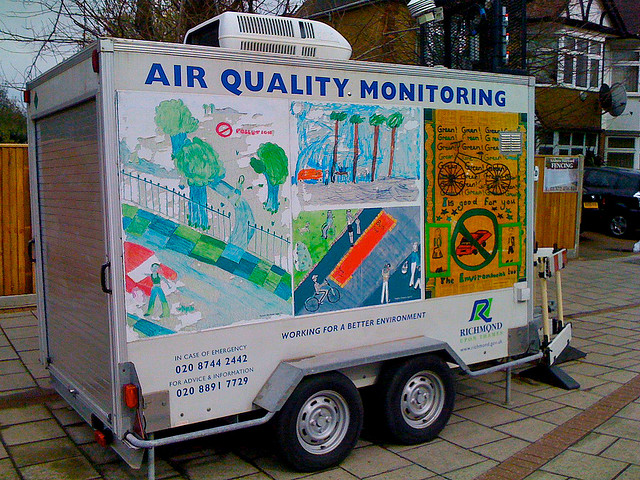
The mobile monitoring station placed in Pavillion measures
the levels of nitrogen oxides, hydrocarbons, particulate matter and ozone to
figure out a level of air quality. The
station measured the air quality from January 2011 through March 2012. After analyzing the data, none of the levels
exceeded any of the standards for air quality monitored by the U.S.
Environmental Protection Agency. The
only level of air quality that came close to being a concern was ozone which
still remained under the legal limit.

Many of the residents were outraged to find out the results
of the tests and said that they did not get a fair sample of air to test. Residents believed the test was unfair
because the mobile monitoring station was placed on a hill that was about 20
feet in elevation above the well field.
Representatives claimed that they careful chose the location
for the mobile monitoring station and took many factors into account including
wind direction, access to electricity, and topography in order to choose the
best location. Even though the results
of the testing say otherwise, the residents of Pavillion believe something is
wrong with their air quality and future testing will likely be done. No testing is currently going on because all
of the mobile monitoring stations owned by EnCana are already in use at other
sites.
-Adam
Tuesday, October 30, 2012
Frack Free Colorado

Being the nerd that I am, I adore Discovery Channel's Mythbusters. What geek doesn't?! On this show, a group of scientists and engineers get together and test myths to see if they are actually true. I thought it would be fun to do a little Mythbustsers blog on a recent protesting event in Colorado. Last week, Denver hosted an event called Frack Free Colorado to inform the public of the dangers of hydraulic fracture stimulation. The event website has a series of facts on hydraulic fracturing and says the event consisted of "a free concert, world-renowned speakers, good ole fashioned protesting & solutions." I want to look at some of these facts a little, Mythbuster style.

Frack Free Colorado Website as documented by Fractivist Blog on Blogger
Fact 1: "Colorado doesn't have enough water. 2-8 million gallons of fresh water are used per well. There are over 48,000 active wells in Colorado. [That equals] half a million olympic sized swimming pools."
Mythbusting: Hydraulic fracturing does use a lot of water, but not every well requires fracture stimulation! The first oil field in Colorado was discovered in 1881 but modern hydraulic fracturing wasn't even put in use until the nineties. Some wells have an economic life of over fifty years, so its likely that out of the 48,000 wells in Colorado, a lot have never received modern fracture stimulation. Also, most companies do everything that they can to re-use completion fluids. Obtaining so much water is expensive and often quite a hassle, so recycling water for multiple wells reduces the concern of massive water volume usage. So, while it is true that frac jobs use a lot of water, it isn't nearly that much!
Fact 2: "Of the 300+ chemicals presumed in fracking fluids: 40% are endocrine distributers, 30% are suspected carcinogens, more than 30% are developmental toxicants, [and] over 60% can harm the brain and nervous system"
Mythbusting: In traditional hydraulic fracture stimulation, there are a lot of chemicals used. Chemicals can be added to the frac fluid for many reasons, be it inhibiting bacteria that is in the water from growing in the well or reducing the viscosity of the fluid (making it easier to push down the hole). As with any field though, improved technology is reducing the number of chemicals used in frac fluid. More companies are working towards "green frac fluid," some of which Halliburton's CEO is willing to drink!
Fact 3: "Fracking is worse for human, environmental, and climate health than coal"
Mythbusting: Frack Free Colorado gets this fact from Shane Davis, an volunteer research biologist for the Sierra Club. The link in the reference brings you to a blog called the Fractivist. This blog, which also posted on the Frack Free Colorado event, has many bold claims and facts in their posts, but no references for the data, making it difficult to track this fact. Since I cannot play mythbusters with the sources used for this fact, I will share what I know on this topic. Hydraulic fracturing is required for the economic production for most of the natural gas in America. Natural gas is a cleaner source of energy than coal, "natural gas produces half as much carbon dioxide, less than a third as much nitrogen oxides, and one percent as much sulfur oxides at the power plant [than coal.]" Hydraulic fracturing is a process that can assist the U.S. in achieving a greener energy portfolio. According to Science Daily, the increased production of natural gas, due to hydraulic fracturing in shale formations, has created a surplus of coal in our economy. The coal is being exported rather than being used in America, making the U.S. more "green." Coal is an extremely dirty energy source, natural gas is MUCH cleaner.
There are a lot more facts from this website that I would love to look into a little more, but I don't want to make a three page post! Let me know if you see any that you would like to know more about!
-Kelsi
Thursday, October 25, 2012
More on Pavilion, WY
Last week Adam wrote a post about the water contamination in Pavilion, Wyoming. This post contained a lot of information and summarized much of what the report said; however, because of the length of this report and the significant amount of information it entailed, I would like to add onto what Adam said and give more information regarding the report.

People in Pavilion had noticed a foul taste and smell to their drinking water, so they notified the Environmental Protection Agency (EPA) about this and complained until they said they would come out and conduct a study. In this study, many hydrocarbons and other compounds that can be related to hydraulic fracturing and natural gas production were found in the soil as well as the water.
These compounds were found to most likely be from hydraulic fracturing and surface pits used during drilling. When a well is drilled, surface pits are used for drilling wastes and produced and flowback waters. These are usually man made and should be cleaned up once the well has been drilled.
So this may make hydraulic fracturing sound like a horrible process and encourage us to discontinue it. However, there is more to consider while reading this report.
First, these wells were drilled in the 1950's. Much has changed since then including drilling technology and certain standards needing to be met. Information was lacking in the well design of these wells in Pavilion, so it is hard to know exactly how they were drilled. Secondly, these wells were only a few hundred feet beneath the surface. In my research, I have never heard of a single well being that shallow. From my experience working at BP America this summer, each of the wells we discussed were all a few thousand feet beneath the surface. Because the wells in Pavilion are so shallow, it is a lot easier for methane and other hydrocarbons to migrate to the water table. Third, the surface casing of these wells "do not extend below the maximum depth of domestic wells in the area of investigation." This goes along with the shallowness of these wells. Finally, there is no baseline information to compare the results from this study to what would have been before hydraulic fracturing occurred.
Overall, these downfalls related to hydraulic fracturing are easy to fix. Simply drill deeper wells to avoid the effects hydraulic fracturing had here.
Currently the EPA is working on getting the water and soil in Pavilion cleaned up. It is difficult to get the funding because there is still no proof of the exact source of these compounds.
I realize this post is long. There is merely too much to say and too little room to say it. If there is any questions about anything that I said, feel free to ask.
-Aubrey Bagley
Tuesday, October 23, 2012
As I completed my first semester as an aspiring Petroleum Engineer, I remember still have some confusion as to what the whole process of drilling and completing a well by means of hydraulic fracturing even looked like. In this industry, it is interesting to think about that Petroleum Engineers are the only engineers that do not actually get to see any of their work. Every that is put into place is done subsurface, and though may be interpreted through microseismic three dimensional modeling, the process is still something that cannot be seen by the naked eye.
There was a video that I saw the summer after my first year of study and it made more sense than the whole two semesters combined. This goes to show that it is very easy for anyone to not understand the oil and gas, exploration and production technology. What tends to happen though in some instances, is that some make outlandish claims without much technical support that really put a negative connotation on the industry as in this California based article. The emphasis of fraccing fluid contamination and link to greenhouse gas is a little unjust, by them insinuating that this takes place every time a well is hydraulically fractured.

For those who have not had much exposure to the drilling, casing, cementing, perforation, and hydraulic fracturing process this is a very beneficial video to gain a great understanding of what actually takes place and how unlikely any type of contamination is with the measures that companies are now taking.
Is this any different than what you thought before? How so?
Bill
There was a video that I saw the summer after my first year of study and it made more sense than the whole two semesters combined. This goes to show that it is very easy for anyone to not understand the oil and gas, exploration and production technology. What tends to happen though in some instances, is that some make outlandish claims without much technical support that really put a negative connotation on the industry as in this California based article. The emphasis of fraccing fluid contamination and link to greenhouse gas is a little unjust, by them insinuating that this takes place every time a well is hydraulically fractured.
For those who have not had much exposure to the drilling, casing, cementing, perforation, and hydraulic fracturing process this is a very beneficial video to gain a great understanding of what actually takes place and how unlikely any type of contamination is with the measures that companies are now taking.
Is this any different than what you thought before? How so?
Bill
Subscribe to:
Posts (Atom)